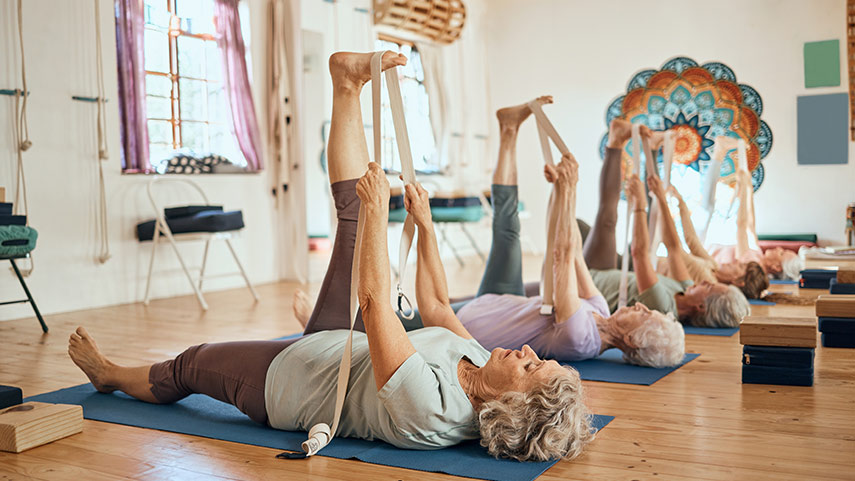
Pilates works across all ages because it scales with ability and goals
The primary objective of Pilates is to provide the individual with an awareness of how their body is moving, stabilized, and aligned. This awareness has value whether you’re lifting a child, training for a marathon, navigating pregnancy, or maintaining balance and independence later in life. As the method of Pilates is adaptable, the cues are simple and the load is variable.
Physical therapists and movement scientists use Pilates-based movements in clinical settings because they are adaptable. They don’t require someone to start with high intensity or heavy resistance on day one. Instead, the physical therapist begins with controlled movements which are gradually increased in intensity as the individual’s abilities develop.
Pilates for kids and teens enhances coordination, posture, and movement confidence
Pilates is suitable for young people, as it helps improve the quality of movement (how you move), body awareness (your internal sense of where your body is) and stability of your core muscles (the foundation for most movements). Unfortunately today, a lot of kids don’t get enough structured movement, and for many, high screen time leaves less room for developing basic coordination.
The benefit of Pilates to youth isn’t about developing maximum strength or high-impact exercise — it’s about helping the nervous system learn how to coordinate and organize the movement, so when a teen runs, jumps, squats or sprints, they will do them with better mechanics.
Pilates for adults supports strength, mobility, and more resilient bodies
For adults in their 20s, 30s, and 40s, Pilates fits neatly into routines that balance life and movement. By this age most people have experienced:
- long hours sitting,
- tension in the back and neck,
- nagging “weak spots” in movement,
- or the realization that “I didn’t know I moved like that.”
Pilates improves core and trunk control, helps open restricted areas, and trains muscles to work together rather than in isolation. That’s why many fitness professionals use Pilates for functional strength and mobility training alongside more traditional resistance or aerobic work.
Data from movement science supports the idea that interventions focusing on neuromuscular control and stability help with mobility and functional outcomes in adults. Targeted exercises like those used in Pilates are among the tools clinicians and trainers choose when the goal is sustainable strength paired with flexibility.
Adults who do Pilates regularly tend to report better posture, fewer movement compensations, and improved awareness of how they perform daily tasks or workouts — and those changes make other types of exercise more effective and safer.
Pilates during pregnancy and postpartum offers modified strength and posture support
Pilates is a great option for both pregnant women and new mothers because it can be adapted to fit the changing anatomical demands of pregnancy and early postpartum. Since Pilates focuses on developing strength by controlling movement rather than relying solely on power and intensity, it allows for the development of strength and proper alignment in the torso with less overall stress on the body.
Many women also find that using Pilates helps them develop the stability and control they need to support their recovering bodies after childbirth. Through the controlled, gentle movement of Pilates, women are able to develop their deep core muscles gradually and learn how to be aware of their bodies in ways that will be helpful when they start lifting or carrying babies again, and when they begin to engage in higher load activities again.
In other words, there is no one standard for what a woman should look like while doing Pilates during this phase of her life. Rather, the focus is on controlled progression at a pace that works best for each individual woman and on allowing her to modify Pilates according to her specific needs. As long as a woman feels capable and confident about moving through space safely, that particular movement is appropriate for this phase of her life.
Pilates for adults in midlife helps counteract stiffness, stress, and early joint overload
Pilates is especially appropriate for adults in their 40s and 50s because this is often when stiffness, stress, and low-grade joint discomfort begin to accumulate. It provides strength without constant impact and mobility without chaotic stretching.
By midlife, many people have years of sitting, repetitive work patterns, or one-sided training habits behind them. The result is usually not dramatic injury — it’s subtle imbalance: tight hips, underactive glutes, neck tension, reduced thoracic mobility.
Pilates addresses those patterns systematically:
- It strengthens deep stabilizers that often go underused.
- It restores controlled spinal mobility.
- It improves how the body distributes load across joints.
For this age group, Pilates works well as either:
- A primary training method when returning to exercise.
- A complementary system alongside strength training, running, cycling, or tennis.
It allows people to build strength and resilience without feeling like every session is a punishment.
Pilates for adults over 60 supports balance, stability, and functional independence
Pilates is appropriate for older adults because it targets exactly what becomes most important with age: balance, controlled strength, and coordinated movement.
As people move into their 60s and beyond, priorities shift. It’s less about performance and more about:
- Staying independent.
- Reducing fall risk.
- Maintaining joint mobility.
- Preserving confidence in movement.
Research examining Pilates in older adults has found improvements in balance and functional performance measures. That does not mean Pilates alone “prevents falls,” but improved trunk control and lower-body stability are meaningful components of fall risk reduction.
Unlike high-impact exercise, Pilates allows older adults to:
- Strengthen without heavy compressive load.
- Train posture and spinal alignment.
- Improve proprioception and coordination.
For many individuals in this age group, especially those who are new to structured exercise, Pilates is an accessible entry point that feels safe yet challenging.
Pilates may not be ideal as a stand-alone solution for every goal
Pilates works across ages because it builds control and balanced strength. But it is not always sufficient on its own depending on the goal.
For example:
- If bone density improvement is the primary objective, weight-bearing and impact exercise should be included.
- If maximal strength or high athletic performance is the goal, progressive resistance training will need to be layered in.
- If someone has acute injury or specific medical conditions, individual assessment is necessary before starting.
Pilates is powerful, but it is most effective when placed correctly within a broader movement strategy.
Choosing the right Pilates format depends on age, experience, and current condition
The method may be consistent, but the format should vary.
For children and teens:
- Shorter sessions.
- Emphasis on coordination and basic strength.
- Clear instructions and supervision.
For adults:
- Mat or reformer depending on experience.
- Progressive loading when appropriate.
- Integration with other physical activity.
For pregnancy and postpartum:
- Individualized modifications.
- Focus on breath, alignment, and controlled strength.
For older adults:
- Smaller groups or private sessions when balance is a concern.
- Controlled pace.
- Emphasis on stability and safe transitions.
Why the quality of the studio matters more than your age
Pilates works at almost any age — but only if it’s taught properly. The method depends on detail. If the details disappear, it turns into something else.
At Corpus Studios™, we teach Pilates the way it was intended: controlled, precise, progressive. Sessions are structured. Movements are coached. Technique comes before speed.
You won’t walk into flashing RGB speaker lights. You won’t hear R&B while everyone rushes through repetitions. And you won’t be pushed into random intensity just to feel like it was“a workout.
Instead, you’ll find:
- Clear instruction grounded in biomechanics.
- Real attention to alignment and breathing.
- Progressions that match your age and experience.
- Small group formats that allow actual coaching.
Joseph Pilates built the method around control, concentration, and intelligent movement. That foundation still matters. Especially if you’re training long-term — whether you’re a teenager building coordination, an adult balancing work stress, or someone over 60 focused on stability.
FAQ
Yes. Pilates can be adapted for beginners in the teen years, adulthood, and older age. The exercises can be modified in intensity and complexity, making it accessible at different fitness levels.
Many studios introduce Pilates-style training around ages 8–10, focusing on coordination, posture, and basic strength rather than heavy resistance or advanced apparatus work.
Yes. Pilates is often appropriate for adults over 60 because it emphasizes balance, controlled strength, and joint-friendly movement. Exercises can be adjusted for mobility limitations or balance concerns.
In uncomplicated pregnancies, modified Pilates can support posture, breathing, and controlled strength. Exercises should always be adapted to the trimester and individual needs.
Pilates builds functional strength and muscular endurance at any age. While it may not replace heavy resistance training for maximal muscle gain, it improves stability and balanced strength.
Pilates improves movement quality and core strength but is often most effective when combined with cardiovascular training and, when appropriate, progressive resistance or weight-bearing activity.