CoreAlign® and Scoliosis: Working With Your Spine, Not Against It
By Kelly McKinnon, BFA, DO — Director of Corpus Studios™, osteopath
If you’re an adult with scoliosis in Brussels, you’ve probably heard a lot about what you shouldn’t do, and much less about what you can. This article is about the second part — and about one apparatus we find genuinely useful for spinal asymmetries: the CoreAlign®. Corpus Studios™ is the only studio in Brussels with this equipment, and the only one that uses it in group classes, so we get asked about it a lot.
What is the CoreAlign®?
The CoreAlign® was developed by physical therapist Jonathan Hoffman and is made by Balanced Body®, the same company behind much of the world’s Pilates apparatus. Picture a standing frame with a ladder at one end and two independent sliding carriages under your feet, each loaded with adjustable spring resistance. Unlike most studio equipment, you work mostly upright — walking, lunging, balancing, reaching — which makes the training remarkably close to how your body actually moves through a day.
Why it suits scoliosis work
Scoliosis is three-dimensional: the spine curves and rotates, and the body builds its own patterns of compensation around that shape. Because CoreAlign® work happens standing, those patterns are visible and workable — you and your instructor can both see how each side behaves, and the two independent carriages let each side of the body work at its own level of resistance. That asymmetric adjustability is exactly what a scoliotic spine needs more of, and what most symmetric training misses.
Our philosophy follows what practitioners in the CoreAlign® community — including Balanced Body® educators who train with scoliosis themselves — describe well: the goal is not to “correct” the curve. It is to work with the patterns the body naturally falls into, build strength and breath on both sides, and give the spine more options to move. Balanced Body® educators summarise their scoliosis approach as the ABCDs: Assessment, Breathing, Centering and De-rotation. In the studio, that translates into careful observation first, movement second.
How we work with scoliosis at Corpus Studios™
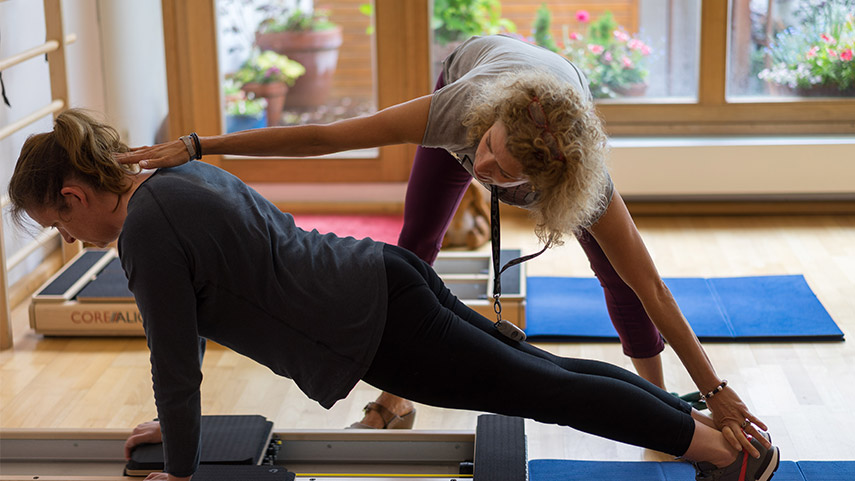
Three of our instructors are specialised in working with scoliosis, and every first session is exactly two things: balanced and adaptive. We look at how your body organises itself, set the springs for each side individually, and build from what your spine can do today — not from a textbook template. From there, you can continue in private sessions or join our CoreAlign® group classes at Studio Borrens, where eight machines run side by side (Studio Caroly has one more for private work).
What we're careful with
Experience with scoliosis clients has taught us where caution pays. Rolling movements can be problematic, as can twisting under load, weight pressing down from above, and inverted positions. None of these are absolute bans — bodies differ, and so do curves — but they are the places where we slow down, adapt, or choose a different path to the same goal. This is also why we’d rather you start with instructors who specialise in this, not with a generic group class.
A note on medical care
Movement training complements medical care for scoliosis; it doesn’t replace it. If you’re under the care of a physician, physiotherapist or orthopedist, keep them in the loop — we’re happy to work alongside your treatment plan, and as an osteopath I’ll tell you honestly when something is outside what movement work should be doing.
FAQ
Can CoreAlign® fix my scoliosis?
No, and be wary of anyone who promises that. What movement training on the CoreAlign® can realistically do: build strength and breath on both sides of your body, improve balance, posture and body awareness, and make daily movement easier and more confident. For many adults with scoliosis, that is a meaningful change in quality of life — it’s just not a change in the curve on your X-ray, and we won’t pretend otherwise.
Is CoreAlign® training safe with scoliosis?
With specialised instruction, yes — that’s the point of it. The apparatus itself is gentle: you stand supported by the frame, resistance is set per side and per exercise, and nothing forces your spine anywhere. The safety comes from the instructor knowing what to adapt: we’re cautious with rolling, loaded twisting, weight from above and inversions, and we scale everything to your pattern. Three of our instructors are specialised in scoliosis work.
Should I start with a private session or a group class?
With scoliosis, start private. One or two individual sessions let us assess your pattern, find your spring settings and teach you the basic movements at your pace. After that, most clients are comfortable joining the CoreAlign® group classes — and because we’re the only Brussels studio running CoreAlign® in group format, the class sizes stay small and the instructor still sees every repetition.
Where can I try the CoreAlign® in Brussels?
At Corpus Studios™ — we’re the only studio in Brussels with CoreAlign® equipment. Group classes run at Studio Borrens (Rue Borrens 33, 1050 Ixelles, near Flagey) on eight machines; Studio Caroly (Rue Caroly 33, near Trône) has one apparatus for private sessions. Check the schedule for class times, or write to us and mention scoliosis so we book you with one of the specialised instructors.