
Learn the foundations of Pilates Mat and apparatus, focusing on safe equipment use, alignment, movement fundamentals and beginner-level teaching skills.
The Studio Comprehensive program develops the knowledge and teaching skills required to work across Pilates Mat and the complete studio apparatus, including the Reformer, Cadillac/Tower, Chairs, Barrels and small equipment.
Students learn to connect Mat and apparatus work as an integrated Pilates movement system and develop the skills needed to teach both private and group sessions.
Learn the foundations of Pilates Mat and apparatus, focusing on safe equipment use, alignment, movement fundamentals and beginner-level teaching skills.
Develop intermediate and advanced Pilates repertoire across Mat and apparatus while refining teaching skills, movement analysis, and programming for more complex individual needs.
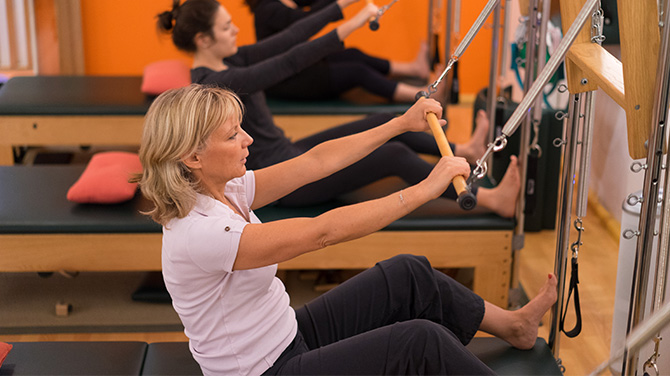
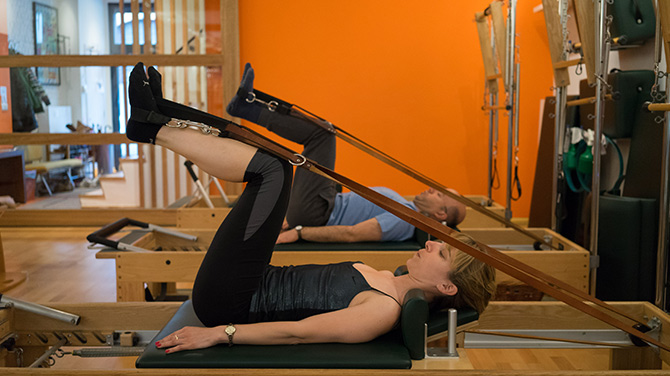
The Studio Comprehensive training incorporates use of the four key pieces of Pilates studio apparatus: Reformer, Cadillac/Tower, Chairs, Barrels. Pilates small apparatus and equipment will also be introduced: Ped-a-Pole, Foot & Toe Correctors, Rotator Discs, Sand Bag, Towel.
The Reformer was the first piece of apparatus created by Joseph Pilates and remains the primary apparatus in a Pilates studio for a full-body workout. The purpose of the Reformer is to provide an unstable surface to which the body must adapt to develop proprioceptive reflexes and improve neuromuscular firing patterns within the body. Spring resistance challenges the body concentrically and builds strength and flexibility. The Reformer is suitable for people of all ages and fitness levels.
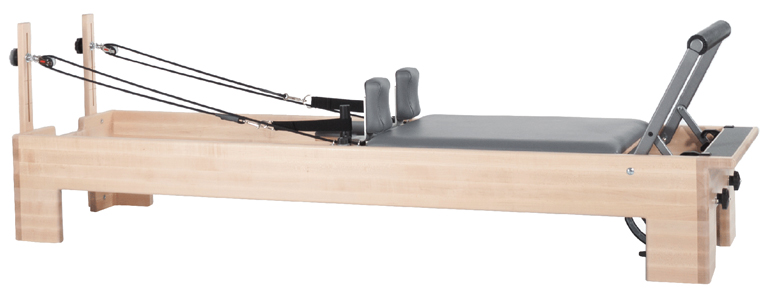
The first Cadillac was created by Joseph Pilates and modeled on a hospital bed with the springs attached to the wall. The Cadillac offers a stable surface, spring resistance and allows for a multidirectional range of movement. It is excellent for working small muscle groups and for specific rehabilitative exercises. In a Pilates studio it is used within a workout to address an individual’s specific needs. Most Cadillac exercises can be performed on a Tower (except suspension exercises).
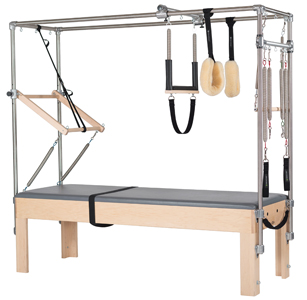
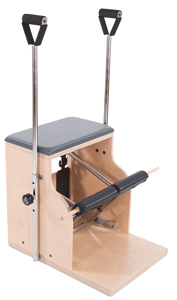
Originally designed by Joseph Pilates for use in tiny New York City apartments, the Chair is the most practical piece of Pilates apparatus. It lends itself to use in the home or in small studios and can be used to perform a wide array of exercises, from the rehabilitative to some verging on acrobatics. The practical nature of this apparatus has spawned variations of the original ‘Wunda Chair’; there’s now also the ‘Low Chair’, the ‘High Chair’ and the ‘Arm Chair’. Traditionally, the Chair was used to meet individual needs, but it can be used to add variety and challenge to a group class. Exercises can be done standing or sitting, making it effective for people who are unable to lie down, accessible to pregnant women, and an excellent piece for rehabilitative purposes.
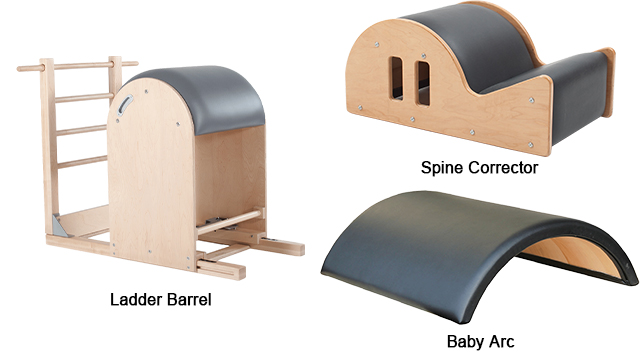
The Barrels were created by Joseph Pilates to put the spine into an “ideal” position to open and decompress the front of the body while developing strength and flexibility. There are many different types of barrels and related small apparatus: ladder barrels, spine correctors, baby arches, and contemporary versions.
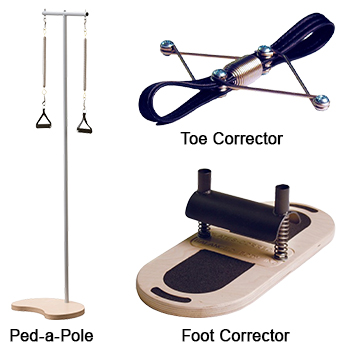
Pilates small equipment provides the opportunity to bring extra focus to an individual’s very specific needs. Small equipment includes: the Ped-a-Pole, to improve postural alignment and strength; the Foot corrector, Toe corrector and Towel – to strengthen and align the toes, feet and ankles; the Sand Bag, to strengthen the hands and wrists. There’s also the Reformer Jump Board, to add a cardio element to a workout, to strengthen the legs and correct foot strike.
Corpus Pilates™ teachers are required to complete 10 hours of Continuing Education Credits (CECs) every two years. The two-year period runs from the year of completion. If you are a continuing student with less than 2 years between courses, then your most recent course counts as your CECs.
Future offerings are listed at www.corpusstudios.com
You can register and pay for a CPIT course either directly through Mindbody or by bank transfer. All students need a Corpus Studios / Mindbody profile to register for a course.
After registering and paying the required course deposit, download and complete the Corpus Pilates™ registration form. Once Corpus Studios has reviewed your registration information and completed form, you will receive confirmation by email.
All students need a Corpus Studios / Mindbody profile to register for a CPIT course.
You can register and pay either directly through Mindbody, using the full Workshops and Instructor Training schedule or the individual course page, or by bank transfer.
Please register for CPIT courses ideally at least two weeks before the course start date. Registration is possible up to one week before the course begins.
Follow the payment instructions and pay the required non-refundable deposit through Mindbody or by bank transfer.
In either case, send confirmation of your payment and enrolment to kelly@corpusstudios.com.
Course fees, deposit amounts, exam fees and any additional payment information are listed on the relevant course page.
After registering and paying your deposit, download and complete the Corpus Pilates™ registration form.
Once completed, email the form to kelly@corpusstudios.com
If you are registering for more than one CPIT course, you do not need to complete a separate registration form for each course.
Corpus Studios will review your registration information and completed registration form, check that you have been correctly registered for the course, and confirm your registration and preferred manual language by email.